Showing posts with label iPad. Show all posts

Students Love Technology [infographic]


Technology advancement has affected each and every walk of life, leaving its effects on all generations. Out of all, Students are considered to be more stirred than anyone else.
Instead of pencils and registers what we see now are tablets and other gadgets. These tech-obsessed students are mostly from age group of 18 – 22.
OnlineEducation.net has plotted following facts in one infographic that depicts how tech-savvy our students are.

'iPhone 4S' and iPad 3 Coming in Late October?

Macotakara reports that it has received information indicating that Apple will be introducing the iPad 3 and "iPhone 4S" sometime early next month, with availability set for "late October". The source offered no information, however, on plans for the iPhone 5, although rumors have suggested that Apple will introduce both a revamped iPhone 5 and tweaked iPhone 4 next month.


According to sources, iPhone 4S which is based on iPhone 4(CDMA) and new iPad will be started produce since 1st week in September and will be shipped in late October.


The "iPhone 4S" name is an unofficial one that has been used in a variety of reports to refer to a new iPhone based largely on and appearing nearly identical to the current iPhone 4, but offering upgraded internal components. What has come to be known as the iPhone 5 is a more thorough redesign which has surfaced in case designs reportedly based on leaked design specs. 


There had been some confusion about whether Apple would be releasing an "iPhone 4S" or "iPhone 5" this year, with some suggesting that the confusion stemmed from Apple testing iPhone 5 components within iPhone 4 enclosures for secrecy. But others have claimed that Apple will indeed be introducing both the iPhone 5 and a tweaked iPhone 4 as rumors of a low-cost iPhone have continued to swirl.

 Apple has of course traditionally kept its older models around as entry-level options, as evidenced Apple's continued sale of an 8 GB iPhone 3GS model, but the volume of rumors suggest that Apple may be doing a bit more tweaking to its low-end offerings this time around. Such low-cost models are said to be key for penetrating the prepaid markets prevalent in a number of large countries around the world.


Macotakara has offered some accurate information in the past, and notably was the first source to pinpoint some of the features of the iPad 2 as case designs began leaking out. A number of potential dates for a media event introducing the iPhone 5 and perhaps the iPad 3 have been suggested, with early reports of a September timeframe being countered early last week with a report from All Things Digital claiming that the device won't be available until October. The latest rumor has, however, claimed a September 7th media event, although an iPhone 5 introduction at that time to be followed with a launch as far off as late October would be outside Apple's usual gap between introduction and availability.

Explosion of Mobile Gaming


Geekaphone, an online resource for the mobile industry, has revealed stats about mobile gaming industry. They have been researching the mobile gaming industry and revealed figures for 2011.
A few key points that stand out are:
  • The mobile gaming industry is predicted to reach $54 Billion by 2015
  • 84% of tablet owners play games
  • 70 – 80% of all mobile downloads are games
  • Android is soon to overtake Apple in number of total available apps
  • In-game purchases should overtake pay-per-downloads by 2013
  • Angry Birds has been downloaded 140 million times
  • Developers made $87 million in ad revenue in 2010 and will grow 10 fold by 2015
Infographic Mobile Gaming Statistics Mobile Gaming Industry Statistics for 2011 [Inforgraphic]

iCloud and iWork Beta Launched For Developers


Apple seems to have opened up the iCloud Beta on iCloud.com. Notably, the login page is nearly identical to a leak from the days before the original iCloud announcement. We were doubtful of the screen at the time, but it appears to have been legitimate. 

There's some mixed reports about people being able to login. We have reports of both developers and non-developers having success and trouble logging in. 


iWork Beta with iCloud support was also seeded to developers: 

Mastering Voice Recognition On Your iPhone, Android, or Desktop


Nobody talks on the phone anymore, but people are talking at their phones. On any platform, check your settings and helper guides to get an understanding of what your app or phone can actually do, as completely misunderstood responses from a speech app can be pretty infuriating. Android phones with Google's Voice Search installed, for example, can make a phone call, compose email, send a text message, get directions, and pull up musical artists-but can't launch applications from vocal commands. This isn't so much an issue on iPhones, but Androids and other phones can have pinhole-style microphones that can get gummed up or partially covered by awkward cases. Intermediate: Stop Slowing Down, But Think Before Speaking You need not talk like a robot to be understood by one, says Vlad Sejnoha, chief technical officer at Nuance, maker of the Dragon speech-to-text software for Windows, Macs, iPhones and iPads.


Dragon's software learns speech styles and tics over time, and you want to aim for a natural speaking flow. Digging around Android forums and elsewhere, I found a good number of tesimonies from speech-to-text enthusiasts who saw better results from simply speaking at a normal clip. Google representative Nadja Blagojevic offered much the same advice for the search giant's voice product in both Android and its Chrome browser: Speak naturally and clearly, but don't strain to enunciate too much or speak slowly. Advanced Dictation: Punctuation and Personalization Another embarrassing thing you can stop doing is holding your phone or desktop microphone directly in front of your mouth. In your Mac's System Preferences, there's a whole range of Speech options, sure; but check in the Input section of the Sound options, and you'll find a check box to Use ambient noise reduction, which Google's Blagojevic recommends for using the Chrome browser's speech function.

The best noise cancellation tools put in cars and hearing aids use multiple microphones to pinpoint the speaker and amplify their Input, but your phone isn't quite as refined an audio tool. Punctuation is no different than words, as Dragon, Google, and most good voice recognition software will train itself to how you say "period," "comma," or even "smiley." Just be sure to actually go back and fix bad Punctuation, as that's often how the software learns. Finally, if you're using an Android phone, be sure that you've enabled Personalized Voice Recognition. It benefits your speech-to-text on Android, in your browser, and, ultimately, your self-driving car.

Mac Os X Lion The Major NEW Features you need to know

The world has changed greatly for Apple in the past few years. As of their earnings statement released Monday, three quarters of all income comes from the iPhone and iPad and the number of users of iOS is already at least four times that of Mac users. After the under-the-hood tweaks and rationalizations of previous operating system update Snow Leopard, the mission for Mac OS X Lion was clear - make the Mac OS comfortable and familiar to the new Apple mobile user audience without putting off established Mac veterans. Can they pull it off?

Installation

So how do you install? You hop on a bus to the Apple Store, buy the Lion upgrade box, get home, take out the enclosed discs and... No you don't. Never again. You log in to the Mac App Store, pay your US$29 and start downloading. Some hours later (it's a 3.74 GB download) you have an 'Install Mac OSX Lion' application in your Applications folder and on the Dock. Apple is pretty laid back about what you do with that installer and you can copy it to any qualifying machines in your household. As per usual there is no serial number or DRM of any kind.
There are some interesting processes going when you double-click on the installer - Apple is creating an invisible partition on your main disk on the fly, installing a clean backup copy of Lion in that partition and then installing your new system Lion from there. It will migrate over all your applications and settings as in previous upgrades but will leave behind any applications that aren't compatible - which basically means apps that rely on Rosetta, Apple's PowerPC translator. From our experience and the reports coming in, the process seems to be robust and free from problems at this time.
The usual warnings apply however. This is the 'point-oh' release and there are bound to be glitches somewhere. Do not install on a 'mission critical' machine for the moment and in particular do not install on your music studio machine because, as seems to be the case with every single upgrade, third-party audio workstation plug-ins are breaking under Lion. Adobe has also reported that there are some issues with pretty well all of their applications including, surprise, surprise, Flash.

Scrolling/Gestures

The iOS influence from the iPhone/iPad family hits you in the face, or at least in the fingers, from the get-go. Lion scrolls the other way. That's right - if you have a mouse with a scroll wheel, a touch pad or indeed the Apple touch-sensitive Magic Mouse, pages on your screen will now scroll in the opposite direction. How you feel about this depends very much on how used to using the iPhone or iPad you are. Like those devices, you are now grabbing the page itself and moving it up and down, rather than the window on the page. Shock two - no scrollbars - or rather scroll bars that only pop into existence when active or when you roll over the edge of the page. When a new window is opened that has hidden scrollable content the bars pop into existence just to let you know and then fade away into the background.
Apple insists that within a few days you will be fully comfortable with this new behavior and won't want to go back. We tend to agree with them. However in the Lion System Preferences you have great control over these aspects of the interface plus the host of new tapping and swiping gestures that are now available and its possible to revert completely to the behavior of the good-old-days (two days ago).

Launchpad

Many inexperienced Mac users apparently have problems finding their applications and if they are not permanently in the Dock will forget where they are. Launchpad is an attempt to mitigate this and is a straight copy of the home screen from iOS. Launched from the Dock or via a hot-key Launchpad displays on screen every launchable app in the applications folder. Just like on iOS you can arrange your apps and pull them together to create folders that can be named. You can also delete apps that you bought in the App Store.
Just like on iOS it actually becomes quite a chore re-arranging your apps into a logical system if you have built up a reasonable collection. If you are a Mac veteran it becomes impossible since your applications folder will be full of all sorts of big apps, little apps, Applescript droplets and various bit and bobs that you just know you will use one day. Launchpad is one of those Apple things that works great for a new user for a couple of months and then is never seen again.

Full Screen

One of the surprising pleasures of the iPad is the fact that applications are always fullscreen. The device becomes the software and vice versa. Lion now brings this capability to the Mac for developers who wish to use the appropriate programming hooks. Most of the Apple apps now have this capability (check your updates) and it works great in apps like iPhoto, Garageband and the new Mail program - i.e. apps that already use a single multi-paned window. It makes little sense for apps that use multiple windows or where the content simply doesn't need the full width of the screen (looking at you Safari). On multiple monitors it only uses one screen and the others are left blank (or at least just showing the new ubiquitous grey linen background texture). It would be nice to see this developed a bit to allow an app per screen for example. The mode is invoked simply by clicking an icon on the top right of the window. In full screen mode mousing to the top of the screen will roll down the menu bar and it can exited from there.

Auto Save/Versions/Resume

Have you ever lost work on your computer? Of course you have. Everybody has. After years and years of being told to keep backups and to keep hitting save while we work, stuff still gets lost or written over by a file we didn't mean to save, or by logging out and not saving open documents. Apple aims to make this a thing of the past by autosaving the changes to every document and then allowing you to browse back in time the different versions of that document, very much in the manner of the now-familiar Time Machine interface.
If the software developer decides to use Apple's updated document model (and they would be crazy not to) the user will never again have to think about saving a document. In addition, when you quit an application the placement and content of all open windows is stored (including where the cursor was and any selections) and then re-stored when the app is launched the next time. In fact, after shutting down, the computer will restart with all open documents and applications as they were before. Very cool.
If this whole idea make you nervous you can still manually save a new version, create a duplicate or chose to lock a document. One suspects however that this new facility will be seen as a significant turning point in document management - once every developer has embraced it of course.

Mission Control

Mission Control is one of the few new headline features in Lion that doesn't seem directly influenced by its mobile iOS brother. Its purpose is to simplify and bring together Exposé, Spaces and Dashboard functionality since many people are apparently still not using these useful screen management functions.
Invoking Mission Control (via the Dock, a Hot Key or touch panel gesture) makes the present desktop recede a little and get overlaid by a row of virtual Spaces desktops - including any full-screen apps and a separate Dashboard Widgets desktop - plus representations of all document windows in use together with icons of their parent application. From here you can quickly get to any window or virtual desktop. You can also drag windows into different desktops and create new ones. It's quicker and more easily understood than the previous arrangements so hopefully more users will be using it to zip between their open documents.

Mail

One application that most people spend a great deal of time in is Mail and it's received a lot of love from Apple in this update with a brand new layout. Messages are at long last to the right of the message list and not below. This makes so much more sense on widescreen monitors. The message list can show a preview of the message (up to five lines) and you can optionally show a sender's thumbnail image if they are in your Address Book file. The default viewing of messages is in a 'conversation' mode where every related message is shown and numbered making it very easy to follow an email thread. This mode also automatically hides all the redundant quoting though you can reveal it if really necessary (with a fun animation).
The familiar mailbox and folder sidebar is available but you can drag any of the item therein to a toolbar above the message window and close the sidebar to increase real-estate. There are a number of often-used commands in that toolbar plus text formatting controls when in email composing mode. Search has been greatly improved using Spotlight's new functionality with search items being quickly auto-suggested. Plus, after one search term has been defined, auto-suggestions for a second term come up making it much quicker to drill down to the message you are searching for. It's easier to use than describe and feels really slick. Fun feature - email flags can now be one of seven colors, not just red. The new Mail is a great improvement.

iCal/Address Book

The iCal and Address Book applications have also received attention in Lion but unfortunately this is one area where the iOS influence is unwelcome. Apple has maintained a deeply skeuomorphic design for both that is perfectly logical in the context of the iPhone/iPad but makes no sense at all on the non-touch vastness of a desktop monitor. They both work as expected with some additional features but the leather, cloth and torn paper appearance is taken to silly levels.
It would be nice if one day Apple provided us with the more powerful general purpose database and time-management tools that Address Book and iCal could become. Unfortunately it seems we are stuck with them as 'apps'. Address Book now has fields for Twitter and 'Profiles' (Facebook, LinkedIn etc.) and iCal does have the nice new feature of a yearly view where your busiest days are represented as red or amber 'hot spots' and your free days in white. Nice touch.

AirDrop

AirDrop is potentially a very useful little feature in a busy office environment. Click on the AirDrop folder in the Finder sidebar and every nearby Mac with Wi-Fi on will pop up. They don't even need to be on the same network. You drag a file onto the Mac you want to send it to and a dialogue asking for permission to receive it pops up on their desktop. Genius.

Security

Something that won't get a lot of press but has clearly been a priority for Apple is the greatly improved security of the operating system to protect against crashing and the malicious hacking of data. the 'sandboxing' (separation of the privileges of each process so that it cannot not be coerced into something else and crash the app) of the System itself has been going on since Leopard. Now it is available for use by developers and will in the future be mandatory for applications to be sold in the Mac App Store. FileVault now encrypts at high speed at the disc level rather than file level and can encrypt whole Time Machine back-ups which is a great improvement. Don't lose that password.
Every Mac OS upgrade has its quirks and caveats but Lion 10.7 feels like it has moved the game along significantly. As always, it will take the developers time to fully embrace the new technologies available to them (er, Adobe?) but Apple has made great efforts with its own apps to show what is possible. It's only US$29 and a million people have already downloaded it in its one day since release. Now bring on iOS5 and iCloud so we can close this circle.
Source: Gizmag

Top 5 features that make Android a better choice over iOS 5

The competition between iOS 5 and Android is getting more intensed day by day. With each update and head-to-head comparison between the biggies, striking similarities as well as dissimilarities have forced millions of gadget lovers to think twice over their smartphone of choice.

Check out the top five useful features of Android that will make it a better choice over Apple's latest build of iOS.


Flexible home screen and widgets
The beauty of Android home screen and widgets is that they are flexible and can be customized according to users' needs. You can easily customize your home screen, place widgets anywhere you want, and they will give you updates on features that matter. You can use widgets for weather updates, breaking news, emails, clocks, WiFi or even media playback controls. When it comes to iOS, users can only launch apps and create folders. 

Customizability
You are free to customize almost anything on your Android. You can extend or replace almost every core Android feature by third-party apps. If you want more, the Android source code is there at your service. You can take the code and customize your ROM, by installing CyanogenMod or Gingerbreak. With Android you can change your default browser to Firefox or any other browser. But in case of iOS, Safari is your only option. If you want to customize your iOS, you need to jailbreak your iOS device.

Better voice control functionality
You just speak and Android brings you what you want. Yes, Android carries voice commands. You can easily search and find with voice search through Google. While listening to music, you just have to speak the title or the artist's name and Android lets you enjoy the music. You can also load third-party music apps like Pandora with the "listen to" command. But in iOS, the voice command options are limited. The music-by-voice feature of the iPhone is only linked to the iPod app.


Flash Support
Android can play Flash games and video, and iOS can't (and never will). It supports only HTML5 web apps. With iOS embracing HTML5 web apps, questions are raised on whether Flash offers what the industry really needs. According to numerous reports, most of the performance related issues have been rectified with Flash for Android Honeycomb.

Google Account Integration
iCloud is interesting. But it's just a cloud storage service. It stores your docs, pictures and apps. With Android, you'll have the benefit of Google Account Integration. You can edit your Google Docs no matter which device you are using, it can be your smartphone, tablet, laptop or desktop. You can upload music to Google Music, and stream from the cloud to your phone. You even can do a VoIP call via Google voice. But with iOS, you neither get streaming music nor VoIP.

GPS Navigation
Voice-guided GPS is a service which has been there in Android phones as a standard component since October 2009. Although iPhone has some third-party apps that offer turn-by-turn voice guidance, with Android's built-in functionality, you can easily jump in to navigate from other apps. In case of iOS, users have to manually copy and paste the address into the app they want to use.

Apple Reports Record-Breaking Q3 2011: $7.31 Billion Profit on $28.57 Billion in Revenue

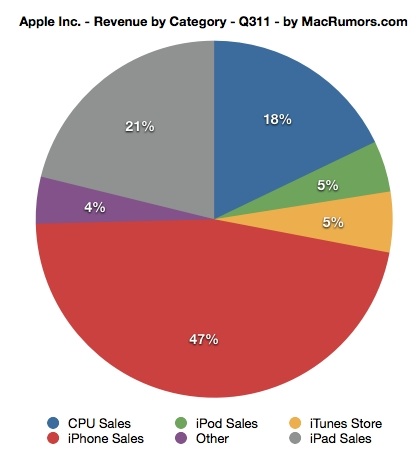
Apple today announced financial results for the second calendar quarter and third fiscal quarter of 2011. For the quarter, Apple posted revenue of $28.57 billion and net quarterly profit of $7.31 billion, or $7.79 per diluted share, compared to revenue of $15.7 billion and net quarterly profit of $3.25 billion, or $3.51 per diluted share, in the year-ago quarter. Gross margin was 41.7 percent, compared to 39.1 percent in the year-ago quarter, and international sales accounted for 62 percent of the quarter's revenue. Apple's quarterly profit and revenue were both company records. 
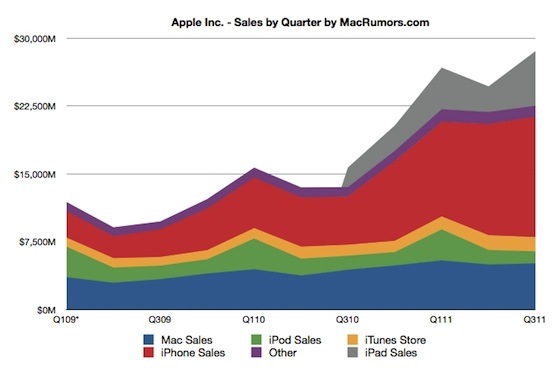

Apple shipped 3.95 million Macintosh computers during the quarter, a unit increase of 14 percent over the year-ago quarter. Quarterly iPhone unit sales reached 20.34 million, up 142 percent from the year-ago quarter, and the company also sold 7.54 million iPods during the quarter, representing 20 percent unit decline over the year-ago quarter. Apple also sold 9.25 million iPads during the quarter, up 183 percent over the year-ago quarter.

"We're thrilled to deliver our best quarter ever, with revenue up 82 percent and profits up 125 percent," said Steve Jobs, Apple's CEO. "Right now, we're very focused and excited about bringing iOS 5 and iCloud to our users this fall."
Apple's guidance for the fourth quarter of fiscal 2011 includes expected revenue of $25 billion and earnings per diluted share of $5.50. 

Apple will provide live streaming of its Q3 2011 financial results conference call at 2:00 PM Pacific, and MacRumors will update this story with coverage of the conference call highlights. 

Conference Call Highlights

- Highest quarterly revenue and profits. Record iPhone and iPad sales and highest June quarter Mac sales ever. 
- Operating margin was a record high. 
- 57% year-over-year Mac growth in Pacific segment. 
OS X Lion launching tomorrow 
- iPod/iTunes continue to lead market. iTunes revenue up 36% year-over-year. 
- Over 225 million accounts, leading music retailer. 
- Thrilled to sell record 20.3 million iPhones. 142% growth, more than double IDC's estimate of overall smartphone market. 
- Asia Pacific sales almost quadrupled over last year. 
- Ended quarter with 5.9 million in channel inventory, up about 700,000 over last quarter.
- 91% of Fortune 500 testing or deploying iPhone; 57% of Global 500. 
- iPad sales up 183%, sold every iPad we could make. 
- Launched iPad 2 in 36 new countries, now in total of 64 countries. 
- 1.05 million iPads in channel inventory, up about 200,000...well below target range. 
- Over 222 million cumulative iOS device sales 
- In June, we previewed iOS 5 and iCloud. Both launching this fall. 
- App Store booming...425,000 apps, 15 billion downloads. $2.5 billion paid out to developers. 
- Retail stores: $3.5 billion, up 36% year-over-year. 50% of Mac purchasers new to Mac. 
- 327 total stores, with four opened during the quarter 
- 73.7 million visitors, up from 60.5 million year-ago quarter. 
- 30 new store openings in September quarter, for a total of 40 in fiscal 2011. 28 outside of U.S. 
- Cash and marketable securities up $10 billion sequentially to $76.2 billion. 
- Now deferring revenue recognition for Lion sales, recognized over period of three years. Same with iCloud. As of June 6th, Apple is deferring $22 of revenue from each Mac sold to be recognized over a period of four years. Also deferring $16 of revenue from each iPhone/iPad and $11 from iPod touch to be recognized over two years. 
- Extremely pleased with record revenue and earnings and customer response to our products. 

Q&A

Q: 12% downtick in revenue guidance is more than usual. Why? 
A: Let me start with the units. For education buying season, September is weighted toward higher education, and we expect increases there. We also expect increases in iPhone, etc. There is also a future product transition that we are not going to talk about today. Those factors are already in our guidance. Confident in our pipeline. Tim Cook talking about some cannibalization of Mac by iPad. But also cannibalizing Windows. Very happy with 14% growth in Mac. 

Q: What about importance of China? 
A: We consider greater China to be Mainland China + Hong Kong + Taiwan. Sales 6x year-over-year. This quarter, revenue $3.8b from Greater China. $8.8b over last 3 quarters from Greater China. "We believe this is a substantial opportunity for Apple and we're just scratching the surface." 

Q: What about margin predictions? 
A: Most components in a very positive pricing situation. HD supply currently constrained but LCD/NAND Flash pricing falling. 

Q: Patent disputes, how to put in context with Apple's IP strategy? 
A: Tim Cook: "We have a very simple view here. That view is we love competition, we think it's great for us and for everyone, but we want people to invent their own stuff. We're going to make sure we defend our portfolio appropriately." 

Q: What drove iPhone strength in the quarter? 
A: Tim: We did add 42 new carriers and 15 new countries in the quarter. We continued our expansion efforts to get out beyond the 225 carrier number and above 100 countries. This occurred throughout the quarter and the real sequential improvement was frankly due to emerging and developed markets. China, Latin America driven by Brazil and Mexico was a big part and the Middle East was a big part of it. It's great for Apple because these are markets that Apple historically has not been as strong in, we're really beginning to see the fruits of our labor in these markets. 

Q: Milestones hoping to hit over the next quarter for iPhone? 
A: It's something that is of great focus to us, we want to do business with great partners and there are great partners for us to do business with. We're always working on new relationships. 

Q: Any thoughts in terms of Android activation numbers relative to Apple? 
A: Android activation number is a difficult one to get our hands around. Unlike our numbers which we can go to our data sheet and add our iPhone and iPad and make a reasonable approximation of iPod touch, you can quickly see in the June quarter we sold 33 million iOS devices. Across time, we're now over 222 million cumulative iOS devices. We think this is incredible. Our numbers are very straightforward, transparent and reported quarterly. 

iPhone is 142% YoY growth. This is 2x the rate of growth of the Smartphone market. We think this is incredible. We sold every iPad 2 in the quarter we could make. There was no shortage of demand. Gaining traction in enterprise. Our intention is not to getting test and pilot programs. We are turning to penetration. 

App store is largest by far, if you look at iPad specific apps we're looking at more than 100,000. You'll be hard pressed to find more than a few hundred on other platforms. Other tablets aren't getting any traction to speak of. We've paid $2.5 billion to developers and it's a great business proposition to them. Well over 15 billion apps downloaded, so customers love it too. Confident with products, app store, developers, customer satisfaction ranks iPhone number 1, so confident with customer reception and confident with our roadmap. 

Q: Apple TV and connected TV market? 
A: Apple TV continues to do well but I don't want to mislead. We still call it a "hobby" and we do that because we don't want anyone to conclude that it's another "leg of the stool" because it's not in the size market that the iPhone, Mac, iPad or iPod is in. We and customers love the product. We really got it right with the new Apple TV but right now it's still a "hobby status". We're continuing to invest in it because we think there's something there. 

Q: Diversify contract manufacturing base and non-Apple Retail channel? 
A: Tim: Regarding non-Apple retail channel, looking at iPhone for example, we have 115,000 points of sale. Incredibly diversified, selling through carriers, through retail, through our online store, direct sales forces to enterprise -- channel is extremely well diversified. Still countries where we're building the channel, so the journey is not complete. But in mature markets, the channel is in good shape. Not something we're worried about. 

Regarding suppliers, we don't want to get into this in any detail. It's part of the magic and part of the things that we have some 'secret sauce' in, and we'd prefer not to share it. 

"Are we too centralized in one place?" The people here involved in supply chain always ask that question, I think we always make the right decision for Apple. 

Q: How is manufacturing yield on iPhone and iPad coming? 
A: Supply of iPad improved through the quarter but we aren't going to comment on specific yield numbers. Further improvements in supply in initial weeks of July and we're in supply demand balance in some countries. Feel very good about progress in that area. 

Q: iPhone growth is extraordinary. How can Apple sustain that growth? Approaching saturation -- make changes or keep the business model? 
A: Apple doesn't set tariff/plan pricing. At a macro level, if you talk to folks around the world, virtually every carrier desires having more customers with smartphones using data. This is a way for them to expand their ARPUs. We believe there is no better device than the iPhone. The ease of use is unparalleled and we believe there is good alignment in that area. 

Key driver in our sequential results in iPhone units are emerging and developing markets. We're putting more energy in these markets that are a big more difficult to do well in than the established countries. We have a very good focus here, we can compete with anyone. 

Q: Including prepaid, indirect distribution markets? 
A: Looking at emerging markets in the aggregate, most of those are prepaid. We believe postpaid is better in the long term for customer, carrier and Apple. In general we are playing in the prepaid market -- not avoiding that market, we know we need to play there in order to have the types of volumes we'd like to have. 

Expanding our channels is obviously on our to-do list. 

Q: Mac growth was 5% sequential, notebook sequential was below that. Past few years have been 17-18%. Was this quarter cannibalization? Anticipation of Lion? 
A: Tim: Look at YoY than sequential on the Mac. Prouder of the numbers that we achieved -- to grow at 14% when the market is growing at 2.6%, doing 5x the rate of growth, is certainly something to be proud of. Why is the number not higher than 14%? No matter how high it is we would focus on that. 

Three things that are the primary factors: First, some cannibalization of new Macs by iPads. Shipped 9.2m iPads during the quarter, 2x the number of Macs shipped. Some customers chose to purchase an iPad instead of a new Mac. But more customers chose to buy an iPad than a Windows PC. 

Second, some customers have delayed purchases until Lion becomes available. We are looking forward to getting Lion out. Guys working very hard on it, it's a fantastic product. Revolutionary change. 

Third, in the year-ago quarter, we launched new MacBook Pros. In this quarter, we launched new iMacs. Both products were well received, however the MBP makes up the majority of the units that we sell in the Mac segment. 

If you change the MBP and its well received, it's going to make the YoY comp more difficult to compare to. Those are the three things impacting Mac growth, but it's already 5x the industry and this is the 21st consecutive quarter that we've beat the market. 

Q: What's the growth look like after this quarter for iPads? 
A: We don't predict unit sales, we aggregate into guidance. Peter said earlier that we think iPads will grow "significantly" year over year. We'll leave the rest of it to [analysts] to conclude. We'll be happy to report in October how you did. 

Q: What are the issues for iPad ramping up production to higher levels? When will we be at equilibrium from production and supply? 
A: This is a good sort of problem per se. Demand is fantastic, so there's not something that we would point to on the supply-side that's a huge issue. To talk about this month, the first weeks of July, supply has further improved since we ended our June quarter. That further improvement have led some SKUs in some countries to be in supply/demand balance. 

We won't predict on other countries, but we're working very hard to get as many units to customers as we can. We've included that thinking in our guidance. 

Q: Anything you're doing different investing in enterprise sales force or going to market on enterprise side? 
A: We have a dual prong strategy with enterprise on both iPad and iPhone. We work with carrier sales forces, and they have large ones, many enterprises want devices connected to the carriers. We train and provide help to carriers on that. We do some sales directly or act as an overlay sales force to a channel that sells to enterprise. 

Still building it out, and we do a bit better each quarter. Very, very happy with numbers on interest and taking customers to pilot and deployment stages. Now we're working on penetration and getting on the standards lists on those accounts. 

To be this far into enterprise with a product that's been shipping for 15 months is incredible. Enterprise is typically much more conservative and takes a long time to evaluate products. People are moving faster than I've seen. 

K-12 takes a long time for new product categories but last quarter we sold more iPads in K-12 than we sold Macs. To do that after just 5 quarters is shocking. We would never have predicted this. We feel very good about iPad. It's clear that it has a universal appeal across many different markets: consumer, enterprise, education, government and so on. 

Q: How is iCloud going to drive more purchases and a halo effect across other devices? 
A: Can't wait to get iCloud and iOS 5 into the hands of customers. We think we've done it right with iCloud -- seamless integrated experience that they're going to love. 

Q: Do you have a lead over competitors to instantly mirror content across device? 
A: We're very, very good with the Internet, with telecommunications and delivering content. We've proven that for a decade over iTunes, App Store and big developer payments. Probably have things to learn but we have a lot of skills and are excited to get iCloud to customers. 

Q: China Mobile has lots of iPhones on its network but it doesn't sell the phone. Sounds like lots of prepaid and unlocked phones on their network. Apple's channel in China is prepaid -- how significant is prepaid in China and other emerging markets? What lessons have you learned? 
A: Prepaid or unlocked phones (phones sold without a contract) are very key in China and in a number of emerging markets where the credit systems are not as well established as they are in Western countries. 

iPhone volume for the first 3 quarters of the fiscal year was up 5x YoY. iPhone is the key contributor to Greater China having a cumulative revenue of $8.8b for the first 3 quarters. I'm not saying that we have figured out precisely how to play perfectly in the environment -- we haven't. We have more to do and more to learn but I feel very good about our progress there. If any of us had been told a year ago that we'd do $3.8 billion in Greater China in a quarter, we wouldn't have believed it and you wouldn't have believed it. 

We're taking our learnings and applying it to other markets as well. 

Q: Worldwide market share data is consistent and irrefutable with the iPhone being a share gainer. Market data from a few markets suggests iPhone has lost share. Most of market share data suggests phones over $300 are going to grow much slower than sub-$300. Where do you fit? 
A: Share gain is important. Any time we're going the wrong way, we are working hard to change that. Regarding multiple price points, we do offer the 3GS which is $49 with a contract in the US. In prepaid markets, it is affected by the channel and taxes so it varies market-to-market but it's clearly a different price than the iPhone 4 is. 

Our philosophy is the same as it always has been. We will only make products that we're proud of and are the best in the world. If we can do that, and the price ends up lower, then we're great with that. 

An example of that is the iPod Shuffle. It started at a different price point and now it's $49. It's a great product and a lot of people love it. 

We'll only make products we're proud of and we want to know, regardless of price-band analysis. It's up to use to convince people to spend a little more for a materially better product. People will do that if the product is great and the message is appropriate. 

Q: What have you learned about media consumption on the iPad? 
A: If you talk to 10 people you'll get 10 reasons why they love it. That's why it's doing so well across people and geographies. 

Q: Why don't we have more movie titles on iTunes at this point? 
A: Broad library of movies and TV shows particularly in the US. Adding more content internationally each quarter. Look for more content later this quarter across the various stores. We have some neat stuff coming.


Source: macrumors